Umang Sisodia • • 3 min read • 7 views

Plasma Curtains Unveil the Mystery Behind Swirling Solar Spicules
Plasma Curtains Unveil the Mystery Behind Swirling Solar Spicules

The Enigmatic Solar Spicules

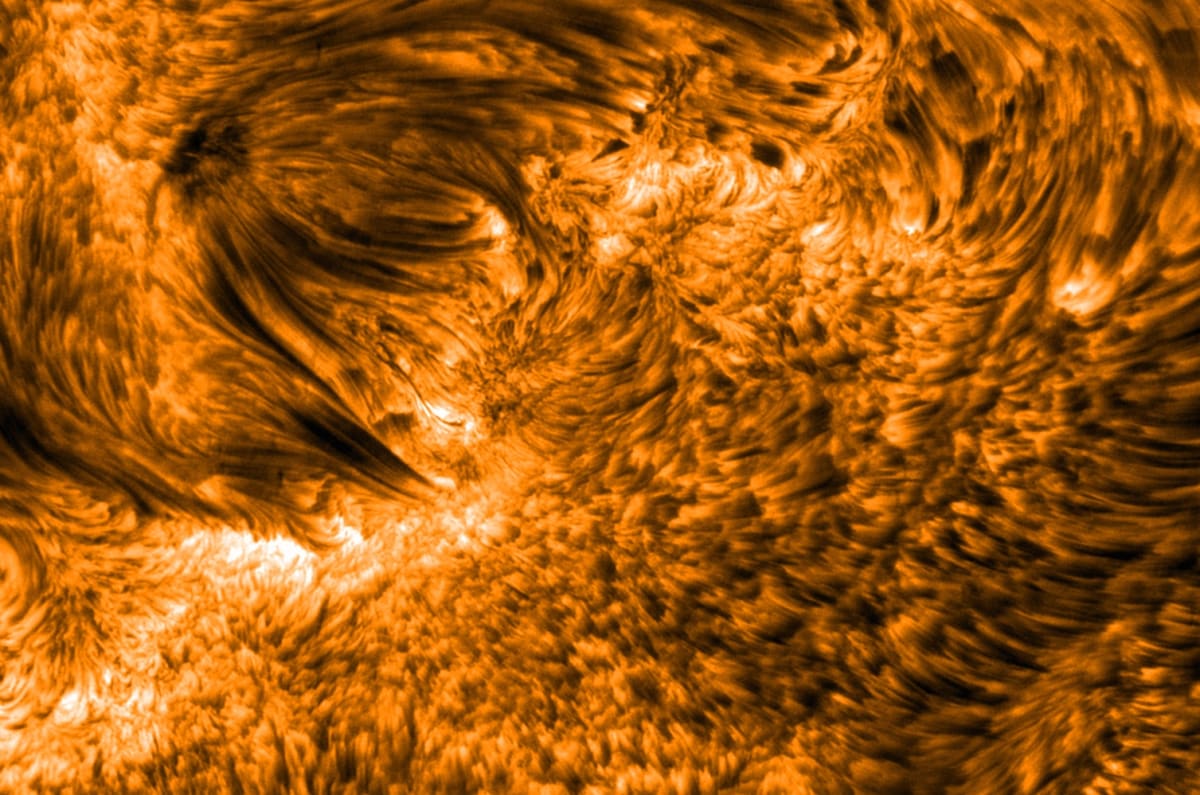
The Sun’s surface is a restless sea of plasma, constantly roiling with magnetic activity. Among its most puzzling phenomena are solar spicules – thin, jet‑like eruptions that shoot up from the chromosphere at speeds of 20‑150 km s⁻¹, reaching heights of up to 10 000 km before fading away. First observed over a century ago, spicules have long been a visual curiosity, but recent high‑resolution observations reveal a hidden choreography: many of them swirl in tightly wound helices, forming patterns that have baffled solar physicists.

What are spicules?

  • Definition: Short‑lived, needle‑like plasma structures that rise from the Sun’s lower atmosphere.
  • Types: Type I (longer‑lived, slower) and Type II (shorter, faster, more energetic).
  • Significance: They may channel a substantial fraction of the Sun’s mass and energy into the corona, possibly feeding the solar wind.

The Plasma‑Curtain Hypothesis

A new study, highlighted by Research Matters, proposes that curtains of plasma—broad, sheet‑like magnetic structures—could be the underlying scaffolding that organizes these swirling spicules. Rather than isolated jets, spicules may be the visible tips of a larger, undulating plasma sheet that twists under the influence of the Sun’s magnetic field.

How curtains could work

  1. Magnetic Shear: Differential rotation of the Sun stretches magnetic field lines, creating shear that rolls the plasma into a curtain‑like topology.
  2. Kelvin‑Helmholtz Instabilities: Velocity differences between adjacent plasma layers trigger vortex formation, imparting the observed swirl.
  3. Reconnection Events: Small‑scale magnetic reconnection punctures the curtain, allowing plasma to burst outward as spicules.

High‑definition data from the Solar Dynamics Observatory (SDO) and the Interface Region Imaging Spectrograph (IRIS) show elongated, ribbon‑like structures that align with the curtain model, supporting the hypothesis.

Implications for Solar Physics

  • Energy Transport: If spicules are the tips of curtains, they could convey energy more efficiently from the photosphere to the corona, refining our understanding of coronal heating.
  • Space Weather Forecasting: Better grasp of spicule dynamics may improve predictions of solar wind variability, which affects satellite operations and power grids on Earth.
  • Magnetohydrodynamic (MHD) Modelling: The curtain concept invites new 3‑D MHD simulations that capture sheet‑like magnetic geometry, moving beyond the traditional tube‑centric models.

Looking Ahead

The curtain hypothesis is still in its infancy. Future missions such as Solar Orbiter and Parker Solar Probe will provide unprecedented close‑up measurements, allowing scientists to test whether these plasma sheets truly act as the backstage curtains behind the Sun’s most dramatic performances.

Key Takeaways

  • Swirling spicules may be manifestations of larger plasma curtains.
  • Magnetic shear and instabilities likely drive the curtain’s twisting motion.
  • Understanding curtains could unlock answers to the long‑standing coronal heating problem.
  • Upcoming solar missions will be crucial in validating this emerging model.

Stay tuned as the Sun continues to reveal its hidden layers, turning what once seemed like a simple flicker into a grand, plasma‑filled ballet.


Original Reporting & Source: Research Matters

Discussion (0)

Sign in to join the discussion.

No comments yet. Be the first to start the conversation!

| |

Plasma Curtains Unveil the Mystery Behind Swirling Solar Spicules

By Umang Sisodia • 3 min read • 7 views

The Enigmatic Solar Spicules

The Sun’s surface is a restless sea of plasma, constantly roiling with magnetic activity. Among its most puzzling phenomena are solar spicules – thin, jet‑like eruptions that shoot up from the chromosphere at speeds of 20‑150 km s⁻¹, reaching heights of up to 10 000 km before fading away. First observed over a century ago, spicules have long been a visual curiosity, but recent high‑resolution observations reveal a hidden choreography: many of them swirl in tightly wound helices, forming patterns that have baffled solar physicists.

What are spicules?

  • Definition: Short‑lived, needle‑like plasma structures that rise from the Sun’s lower atmosphere.
  • Types: Type I (longer‑lived, slower) and Type II (shorter, faster, more energetic).
  • Significance: They may channel a substantial fraction of the Sun’s mass and energy into the corona, possibly feeding the solar wind.

The Plasma‑Curtain Hypothesis

A new study, highlighted by Research Matters, proposes that curtains of plasma—broad, sheet‑like magnetic structures—could be the underlying scaffolding that organizes these swirling spicules. Rather than isolated jets, spicules may be the visible tips of a larger, undulating plasma sheet that twists under the influence of the Sun’s magnetic field.

How curtains could work

  1. Magnetic Shear: Differential rotation of the Sun stretches magnetic field lines, creating shear that rolls the plasma into a curtain‑like topology.
  2. Kelvin‑Helmholtz Instabilities: Velocity differences between adjacent plasma layers trigger vortex formation, imparting the observed swirl.
  3. Reconnection Events: Small‑scale magnetic reconnection punctures the curtain, allowing plasma to burst outward as spicules.

High‑definition data from the Solar Dynamics Observatory (SDO) and the Interface Region Imaging Spectrograph (IRIS) show elongated, ribbon‑like structures that align with the curtain model, supporting the hypothesis.

Implications for Solar Physics

  • Energy Transport: If spicules are the tips of curtains, they could convey energy more efficiently from the photosphere to the corona, refining our understanding of coronal heating.
  • Space Weather Forecasting: Better grasp of spicule dynamics may improve predictions of solar wind variability, which affects satellite operations and power grids on Earth.
  • Magnetohydrodynamic (MHD) Modelling: The curtain concept invites new 3‑D MHD simulations that capture sheet‑like magnetic geometry, moving beyond the traditional tube‑centric models.

Looking Ahead

The curtain hypothesis is still in its infancy. Future missions such as Solar Orbiter and Parker Solar Probe will provide unprecedented close‑up measurements, allowing scientists to test whether these plasma sheets truly act as the backstage curtains behind the Sun’s most dramatic performances.

Key Takeaways

  • Swirling spicules may be manifestations of larger plasma curtains.
  • Magnetic shear and instabilities likely drive the curtain’s twisting motion.
  • Understanding curtains could unlock answers to the long‑standing coronal heating problem.
  • Upcoming solar missions will be crucial in validating this emerging model.

Stay tuned as the Sun continues to reveal its hidden layers, turning what once seemed like a simple flicker into a grand, plasma‑filled ballet.


Original Reporting & Source: Research Matters