Umang Sisodia • • 6 min read • 2 views

CBSE’s 2028 Class 10 Blueprint: 5 Core Subjects, Optional Skill Paper & What It Means for Indian Education

Listen to Article
Select a voice and press play
CBSE’s 2028 Class 10 Blueprint: 5 Core Subjects, Optional Skill Paper & What It Means for Indian Education

Key Takeaways

  • Five compulsory subjects will be mandatory for Class 10 board exams starting 2028, tightening the core curriculum.
  • An optional skill‑based paper serves as a safety net, allowing students to offset a low score in one core subject.
  • The move follows a series of CBSE clarifications over the past year, aiming to balance academic rigor with skill development.
  • Stakeholders are divided: educators praise the holistic intent, while parents worry about added pressure and implementation logistics.

The Central Board of Secondary Education (CBSE) has once again captured national attention, this time with a sweeping revision to its Class 10 assessment framework slated for 2028. The announcement—"5 compulsory subjects, optional skill paper as safety net"—has surged on Google Trends across India, registering over 200 daily searches in the education‑focused query "class". Media outlets like The Hindu, Telegraph India, and India Today have amplified the story, dissecting the board’s rationale and the ripple effects on students, teachers, and the broader education ecosystem.


What the New Scheme Entails

The Five Core Subjects

CBSE’s revised syllabus mandates that every Class 10 student sit for exams in Mathematics, Science, Social Studies, English, and a second language (regional language or Hindi). This aligns with the board’s long‑standing emphasis on a well‑rounded academic foundation.

The Optional Skill Paper

In a notable departure from past policies, CBSE will introduce an optional skill‑based paper—covering areas such as coding, digital literacy, vocational trades, or creative arts. Students can elect to appear for this paper, and a minimum score of 40% can be used to offset a lower mark (below 33%) in any of the five core subjects, effectively acting as a safety net.

Assessment Structure

  • Core exams: Traditional written papers, each carrying 100 marks.
  • Skill paper: 50‑mark assessment, evaluated through project work, practical demonstrations, or a written component depending on the chosen skill.
  • Result calculation: Final percentage will be a weighted average, with the skill paper contributing up to 10% of the total score.
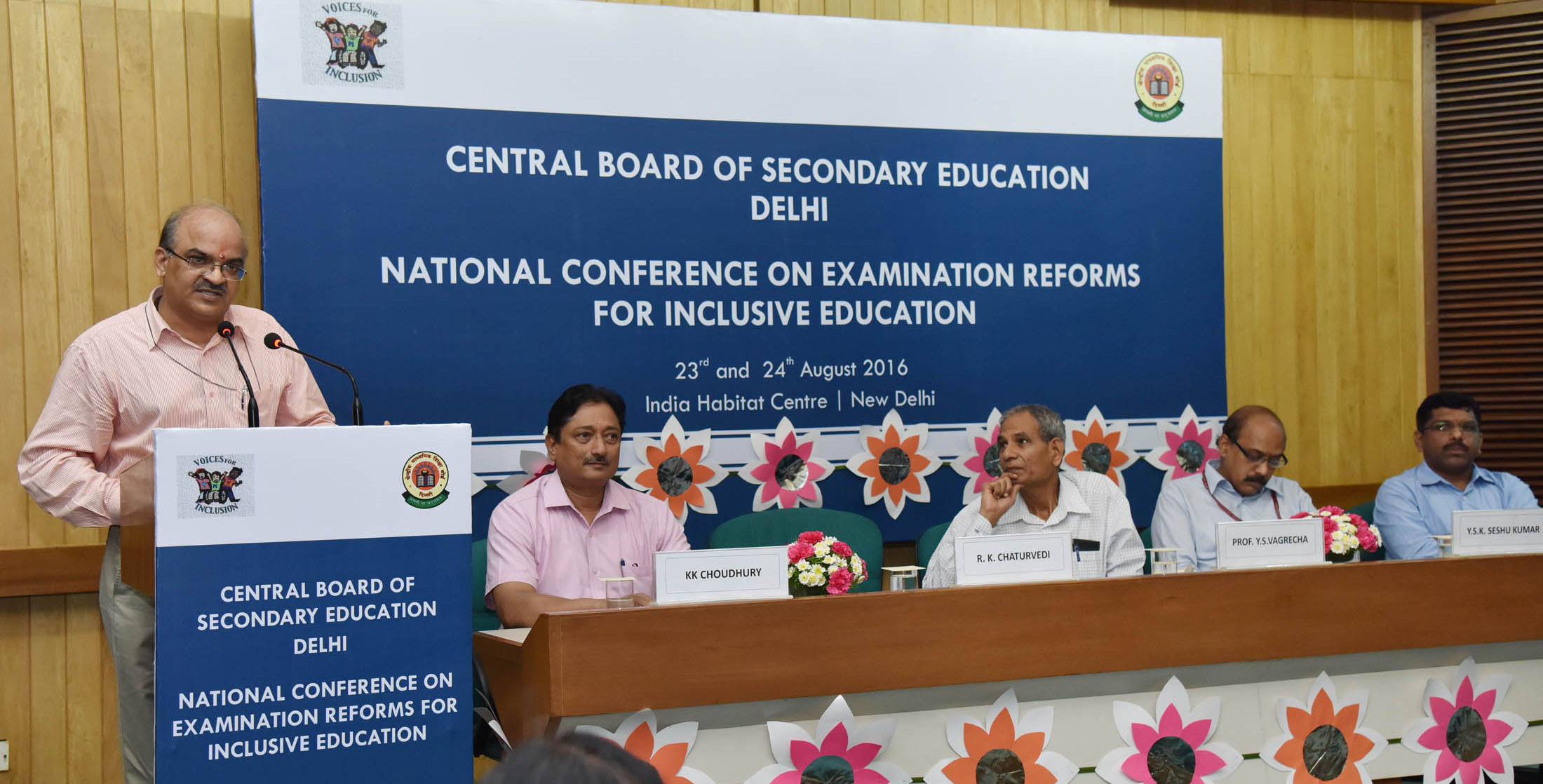
CBSE press conference Delhi CBSE press conference Delhi


Background: A Year of Clarifications

The 2028 blueprint did not emerge in a vacuum. Over the past twelve months, CBSE released six major clarifications addressing curriculum changes, assessment methods, and grading criteria. These included:

  1. Revised board exam dates post‑COVID disruptions.
  2. Introduction of internal assessment marks for practical subjects.
  3. Guidelines for the new Continuous and Comprehensive Evaluation (CCE) model.
  4. Adjustments to the grading scale to reduce grade inflation.
  5. Proposals for integrating digital tools in classroom teaching.
  6. The current five‑subject, skill‑paper framework.

Each clarification was met with mixed reactions, highlighting the board’s struggle to balance standardization with flexibility.


Reactions from Stakeholders

Educators and Administrators

Many senior teachers view the skill paper as a progressive step toward competency‑based education. "It encourages students to develop practical abilities that are often neglected in rote‑learning environments," says Dr. Anjali Mehta, Principal of Delhi Public School, Rohini.

However, school administrators caution about logistical challenges—training teachers, sourcing assessment materials, and ensuring uniform evaluation across the country.

Parents and Students

Parent‑teacher associations (PTAs) have expressed concern over added pressure. While the safety net concept is welcomed, the fear of an extra exam and the uncertainty around skill‑paper grading criteria loom large.

Students, particularly those from rural backgrounds, worry about access to skill‑training resources. "If my school cannot provide a coding lab, how will I compete?" asks 15‑year‑old Rohan Singh from Uttar Pradesh.

Policy Experts

Education analysts see the move as part of a broader national push—the National Education Policy (NEP) 2020’s emphasis on multidisciplinary learning. Prof. Vikram Patel, education policy researcher, notes: "CBSE’s scheme operationalizes NEP’s vision by embedding skill acquisition within the board exam framework."


Potential Benefits and Pitfalls

Benefits

  • Holistic development: Balances academic knowledge with practical skills.
  • Reduced exam stress: The safety net can prevent a single poor performance from derailing a student’s overall result.
  • Future‑ready learners: Aligns with industry demands for digital and vocational competencies.

Pitfalls

  • Implementation disparity: Urban schools may adapt quickly, whereas under‑resourced schools could lag.
  • Assessment fairness: Standardizing evaluation for diverse skill areas poses a challenge.
  • Curriculum overload: Adding a skill paper may increase workload for both students and teachers.

Comparative Lens: International Benchmarks

Countries like Finland and Singapore have long integrated skill‑based assessments alongside academic exams. Finland’s “basic education” model emphasizes project‑based learning, while Singapore’s “Applied Learning” tracks allow students to earn certifications in technical fields. CBSE’s approach mirrors these models, aiming to bridge the gap between academic theory and real‑world application.


Editorial Analysis & Future Outlook

The CBSE’s 2028 scheme is a landmark policy shift that could redefine secondary education in India. By mandating five core subjects while offering an optional skill paper, the board attempts to harmonize depth with breadth—a core tenet of the NEP 2020.

Short‑term, schools will grapple with resource allocation, teacher upskilling, and curriculum redesign. Successful pilots in metropolitan districts may become templates for nationwide rollout, but the risk of implementation inequity remains high.

Long‑term, if executed effectively, the skill paper could become a credential of its own, recognized by higher education institutions and employers. This may encourage a cultural shift where practical competence complements academic achievement, potentially reducing the over‑reliance on rote memorization.

For policymakers, the key will be continuous monitoring—collecting data on student performance, skill‑paper uptake, and regional disparities—to fine‑tune the framework. Collaboration with industry partners for skill‑training modules, and leveraging digital platforms for remote learning, could mitigate resource gaps.

In essence, the CBSE’s move signals a progressive, albeit ambitious, transformation. Its success will hinge on strategic execution, stakeholder buy‑in, and an unwavering focus on equitable access. If these elements align, India’s Class 10 board exams could evolve from a high‑stakes hurdle into a springboard for holistic, future‑ready education.


Stay tuned for updates as schools begin pilot implementations and the first batch of students prepares for the 2028 board examinations.


Original Reporting & Source: Google Trends (India)

Discussion (0)

Sign in to join the discussion.

No comments yet. Be the first to start the conversation!

| |

CBSE’s 2028 Class 10 Blueprint: 5 Core Subjects, Optional Skill Paper & What It Means for Indian Education

By Umang Sisodia • 6 min read • 2 views

Key Takeaways

  • Five compulsory subjects will be mandatory for Class 10 board exams starting 2028, tightening the core curriculum.
  • An optional skill‑based paper serves as a safety net, allowing students to offset a low score in one core subject.
  • The move follows a series of CBSE clarifications over the past year, aiming to balance academic rigor with skill development.
  • Stakeholders are divided: educators praise the holistic intent, while parents worry about added pressure and implementation logistics.

The Central Board of Secondary Education (CBSE) has once again captured national attention, this time with a sweeping revision to its Class 10 assessment framework slated for 2028. The announcement—"5 compulsory subjects, optional skill paper as safety net"—has surged on Google Trends across India, registering over 200 daily searches in the education‑focused query "class". Media outlets like The Hindu, Telegraph India, and India Today have amplified the story, dissecting the board’s rationale and the ripple effects on students, teachers, and the broader education ecosystem.


What the New Scheme Entails

The Five Core Subjects

CBSE’s revised syllabus mandates that every Class 10 student sit for exams in Mathematics, Science, Social Studies, English, and a second language (regional language or Hindi). This aligns with the board’s long‑standing emphasis on a well‑rounded academic foundation.

The Optional Skill Paper

In a notable departure from past policies, CBSE will introduce an optional skill‑based paper—covering areas such as coding, digital literacy, vocational trades, or creative arts. Students can elect to appear for this paper, and a minimum score of 40% can be used to offset a lower mark (below 33%) in any of the five core subjects, effectively acting as a safety net.

Assessment Structure

  • Core exams: Traditional written papers, each carrying 100 marks.
  • Skill paper: 50‑mark assessment, evaluated through project work, practical demonstrations, or a written component depending on the chosen skill.
  • Result calculation: Final percentage will be a weighted average, with the skill paper contributing up to 10% of the total score.

CBSE press conference Delhi CBSE press conference Delhi


Background: A Year of Clarifications

The 2028 blueprint did not emerge in a vacuum. Over the past twelve months, CBSE released six major clarifications addressing curriculum changes, assessment methods, and grading criteria. These included:

  1. Revised board exam dates post‑COVID disruptions.
  2. Introduction of internal assessment marks for practical subjects.
  3. Guidelines for the new Continuous and Comprehensive Evaluation (CCE) model.
  4. Adjustments to the grading scale to reduce grade inflation.
  5. Proposals for integrating digital tools in classroom teaching.
  6. The current five‑subject, skill‑paper framework.

Each clarification was met with mixed reactions, highlighting the board’s struggle to balance standardization with flexibility.


Reactions from Stakeholders

Educators and Administrators

Many senior teachers view the skill paper as a progressive step toward competency‑based education. "It encourages students to develop practical abilities that are often neglected in rote‑learning environments," says Dr. Anjali Mehta, Principal of Delhi Public School, Rohini.

However, school administrators caution about logistical challenges—training teachers, sourcing assessment materials, and ensuring uniform evaluation across the country.

Parents and Students

Parent‑teacher associations (PTAs) have expressed concern over added pressure. While the safety net concept is welcomed, the fear of an extra exam and the uncertainty around skill‑paper grading criteria loom large.

Students, particularly those from rural backgrounds, worry about access to skill‑training resources. "If my school cannot provide a coding lab, how will I compete?" asks 15‑year‑old Rohan Singh from Uttar Pradesh.

Policy Experts

Education analysts see the move as part of a broader national push—the National Education Policy (NEP) 2020’s emphasis on multidisciplinary learning. Prof. Vikram Patel, education policy researcher, notes: "CBSE’s scheme operationalizes NEP’s vision by embedding skill acquisition within the board exam framework."


Potential Benefits and Pitfalls

Benefits

  • Holistic development: Balances academic knowledge with practical skills.
  • Reduced exam stress: The safety net can prevent a single poor performance from derailing a student’s overall result.
  • Future‑ready learners: Aligns with industry demands for digital and vocational competencies.

Pitfalls

  • Implementation disparity: Urban schools may adapt quickly, whereas under‑resourced schools could lag.
  • Assessment fairness: Standardizing evaluation for diverse skill areas poses a challenge.
  • Curriculum overload: Adding a skill paper may increase workload for both students and teachers.

Comparative Lens: International Benchmarks

Countries like Finland and Singapore have long integrated skill‑based assessments alongside academic exams. Finland’s “basic education” model emphasizes project‑based learning, while Singapore’s “Applied Learning” tracks allow students to earn certifications in technical fields. CBSE’s approach mirrors these models, aiming to bridge the gap between academic theory and real‑world application.


Editorial Analysis & Future Outlook

The CBSE’s 2028 scheme is a landmark policy shift that could redefine secondary education in India. By mandating five core subjects while offering an optional skill paper, the board attempts to harmonize depth with breadth—a core tenet of the NEP 2020.

Short‑term, schools will grapple with resource allocation, teacher upskilling, and curriculum redesign. Successful pilots in metropolitan districts may become templates for nationwide rollout, but the risk of implementation inequity remains high.

Long‑term, if executed effectively, the skill paper could become a credential of its own, recognized by higher education institutions and employers. This may encourage a cultural shift where practical competence complements academic achievement, potentially reducing the over‑reliance on rote memorization.

For policymakers, the key will be continuous monitoring—collecting data on student performance, skill‑paper uptake, and regional disparities—to fine‑tune the framework. Collaboration with industry partners for skill‑training modules, and leveraging digital platforms for remote learning, could mitigate resource gaps.

In essence, the CBSE’s move signals a progressive, albeit ambitious, transformation. Its success will hinge on strategic execution, stakeholder buy‑in, and an unwavering focus on equitable access. If these elements align, India’s Class 10 board exams could evolve from a high‑stakes hurdle into a springboard for holistic, future‑ready education.


Stay tuned for updates as schools begin pilot implementations and the first batch of students prepares for the 2028 board examinations.


Original Reporting & Source: Google Trends (India)